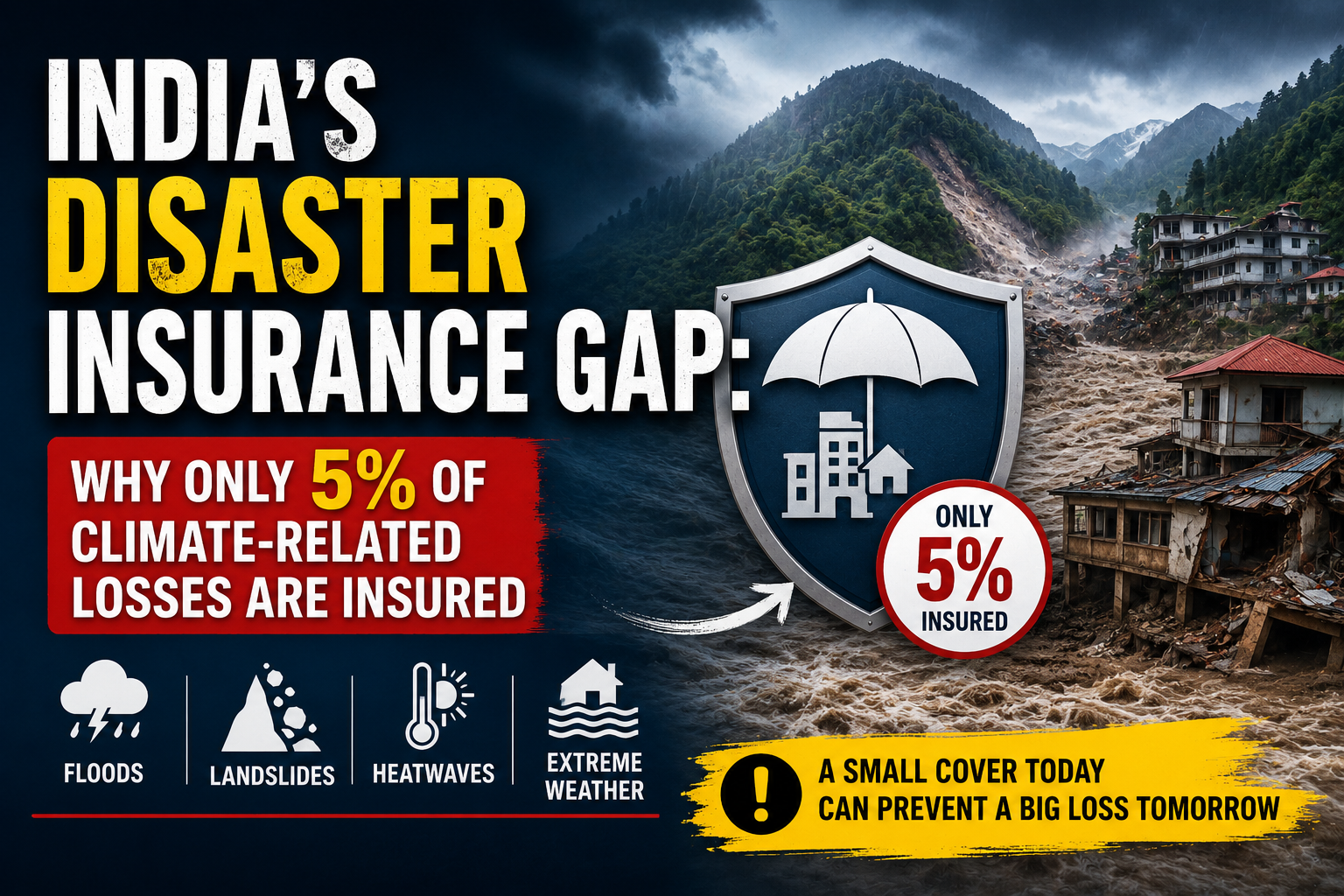
India’s Disaster Insurance Gap: Why Only 5% of Climate-Related Losses Are Insured
Quick Answer: Only around 5% of climate-related losses in India are currently insured, highlighting a major protection gap as floods, landslides, heatwaves and other extreme-weather events become increasingly disruptive. The issue has renewed attention on disaster-risk insurance and newer solutions such as parametric insurance.
Why Is India’s Insurance Gap So Large?
India faces a wide range of natural hazards, but insurance coverage has not expanded at the same pace as economic and climate-related risks.
When a major disaster occurs, families, businesses and governments often bear a significant portion of the financial loss themselves. The Asian Development Bank has noted that most disaster losses remain uninsured, increasing the financial burden on governments during recovery and reconstruction.
For individuals, the problem can involve damaged homes, belongings or loss of income. For businesses, floods, landslides and extreme weather can damage property, equipment, inventory and operations.
What Is Parametric Insurance?
One potential solution receiving growing attention is parametric insurance.
Unlike traditional insurance, which generally requires an assessment of the actual damage, parametric policies pay a predefined amount when a specific measurable event crosses an agreed threshold.
For example, a policy could trigger a payout when rainfall exceeds a specified level or wind speed reaches a predetermined threshold. This can potentially provide funds much faster after a disaster.
India is already experimenting with such approaches. Government programmes and state-level initiatives are exploring weather and disaster-related risk financing, while parametric solutions are being considered for hazards including extreme rainfall and heat.
What Does This Mean for Policyholders?
The protection gap means people should not assume that every natural disaster-related loss will automatically be covered by their existing insurance.
Homeowners and businesses should carefully review their policies for covered perils, exclusions, deductibles and limits. Where appropriate, they should also consider whether additional disaster or business-interruption protection is needed.
Farmers already have access to government-backed crop insurance covering several weather and natural risks through schemes such as the Pradhan Mantri Fasal Bima Yojana (PMFBY). The scheme has also incorporated technology and weather data to improve risk assessment and claims processes.
Why This Matters Now
The recent Himalayan disaster has once again highlighted the enormous financial consequences of extreme weather and the need for stronger disaster-risk financing across South Asia. Reuters reports that experts see parametric insurance as one possible tool for improving the speed and scale of financial protection.
For India, closing the insurance gap will require cooperation between insurers, governments, reinsurers and communities.
The bigger takeaway: insurance cannot prevent a flood, landslide or heatwave but better insurance coverage can help people and businesses recover financially when disasters strike.
Disclaimer: This article is for informational purposes only and does not constitute insurance, financial or legal advice. Coverage depends on individual policy terms, exclusions and conditions.
Disclaimer: This article is for informational purposes only and does not constitute financial or insurance advice. Insurance products are regulated by the Insurance Regulatory and Development Authority of India (IRDAI). Policy terms, premiums, and coverage vary by insurer. Please consult a licensed insurance advisor before purchasing any policy. Read our full disclaimer →