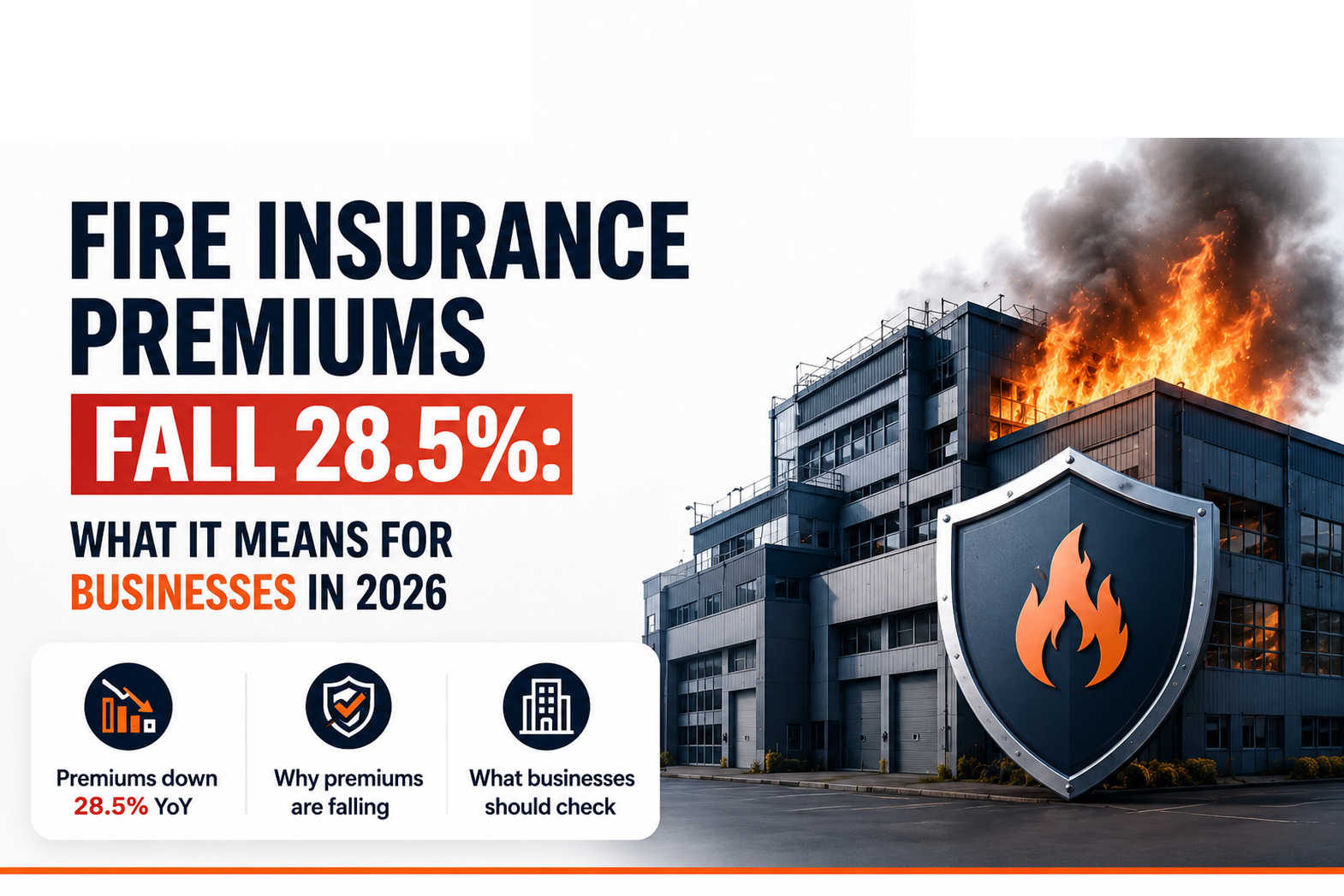
Fire Insurance Premiums Fall 28.5%: What It Means for Businesses in 2026
Quick Answer: Fire insurance premiums in India fell 28.5% year-on-year during April–July 2026, dropping to about ?10,062 crore from ?14,063 crore a year earlier. The decline has been linked largely to aggressive discounting on large industrial and commercial risks and increased competition among insurers.
Why Are Fire Insurance Premiums Falling?
The biggest factor is intense competition for large corporate and industrial accounts. Insurers have been offering substantial discounts to win major fire-risk policies, putting downward pressure on premium rates.
Industry experts also point to a strong supply of reinsurance capacity and relatively favourable loss experience in the segment. More reinsurance capacity has allowed insurers to take on risks more competitively, contributing to lower prices
However, the sharp decline has also raised concerns about whether insurers are pricing risks appropriately.
Is Cheaper Fire Insurance Good News?
For businesses, lower premiums can initially appear to be a positive development. Factories, warehouses, offices and other commercial properties may be able to obtain fire protection at a lower cost.
But the cheapest policy is not necessarily the best policy.
Businesses need to look beyond the premium and examine the sum insured, coverage limits, exclusions, deductibles and claim conditions. A policy with a significantly lower premium could provide inadequate protection if the insured value does not properly reflect the cost of rebuilding or replacing assets.
Why Are Insurers Concerned?
The pricing pressure could affect insurers' profitability if premiums become disconnected from the actual level of risk.
The recent decline has already prompted discussion within the industry about returning to more disciplined underwriting and risk-based pricing. Regulators have also raised concerns about steep discounting in industrial fire insurance
This is particularly important because a major industrial fire can result in very large claims. Insurers need sufficient premium income to maintain their ability to meet such losses.
What Should Businesses Do?
Companies reviewing their fire insurance should not focus solely on getting the lowest possible premium.
Instead, they should:
- Review the property's current replacement value.
- Check whether machinery, inventory and business assets are adequately covered.
- Understand deductibles and exclusions.
- Compare policies from multiple insurers.
- Review business interruption coverage where appropriate.
- Make sure risk information provided to the insurer is accurate.
A lower premium can be useful, but adequate coverage should remain the priority.
The Bigger Picture
The 28.5% decline highlights how competitive India's commercial insurance market has become. While businesses may benefit from lower prices in the short term, insurers must maintain pricing discipline to ensure that premiums remain adequate for the risks being covered.
For businesses, this could be a good opportunity to review existing fire insurance policies but the focus should be on value and protection, not simply the cheapest premium.
Disclaimer: This article is for informational purposes only and does not constitute insurance or financial advice. Policy terms, coverage and premiums vary between insurers and individual risks.
Disclaimer: This article is for informational purposes only and does not constitute financial or insurance advice. Insurance products are regulated by the Insurance Regulatory and Development Authority of India (IRDAI). Policy terms, premiums, and coverage vary by insurer. Please consult a licensed insurance advisor before purchasing any policy. Read our full disclaimer →